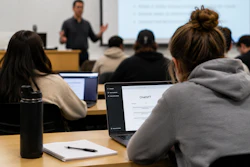
Faculty members are beginning to ask whether they still need as many graduate assistants for certain kinds of research work now that AI systems can summarize literature, generate code, assist with data analysis, and produce early drafts quickly enough to change the pace of projects. Not every faculty member is thinking this way, and many remain deeply committed to mentorship. Still, the conversation itself feels important because it reflects a broader shift in how research labor is being understood.
The public discussion around AI in higher education still tends to focus on efficiency. Faster workflows. Reduced administrative burden. Increased productivity. Universities are under financial pressure, and faculty exhaustion is real. Most people working in higher education can feel that strain now, even if they describe it differently.
What I keep coming back to, though, is something slightly harder to measure. What happens to students whose entry into research communities depended on doing exactly the kinds of work institutions may gradually start viewing as unnecessary or inefficient? The answer probably will not fall evenly.
Students of color have historically experienced higher education differently from many of their peers, even after gaining admission into programs that were supposed to create opportunity. In STEM fields especially, mentorship, faculty sponsorship, research access, and informal academic networks have never been distributed equally. A lot of students learned how academia worked while also trying to convince themselves they belonged there in the first place.
That reality shaped many of the interventions universities built over the last two decades. Undergraduate research initiatives expanded. STEM bridge programs have grown. Mentoring networks became more intentional. Some institutions invested heavily in pathway programs because the disparities had become difficult to ignore publicly.
Some of those efforts genuinely helped. Students who may never have imagined themselves as researchers started presenting at conferences, working in labs, and developing relationships with faculty members who took their work seriously. Research assistantships mattered in ways universities do not always quantify very well. For some students, they became the first sustained point of access to academic culture itself. Not the polished version institutions advertise externally, but the actual rhythms of research work: uncertainty, revision, collaboration, awkwardness, confidence-building, and slow intellectual development.
A student can be academically talented and still spend years feeling out of place in STEM spaces. Sometimes the lab or assistantship becomes the place where that begins to change. A faculty member learns their name. A graduate student mentor spends extra time with them. The conference presentation goes better than expected. None of those moments look especially significant on paper by themselves. Over time, though, they accumulate.
Now AI enters the middle of all of this.
Even mathematics, a field many people still imagine as somewhat insulated from these conversations, is beginning to wrestle with the implications. Mathematician Terence Tao recently noted that AI is forcing mathematics to rethink aspects of graduate education because some of the problems historically used to train young mathematicians now overlap with work AI systems can plausibly handle.
I do not think most universities fully understand what that means yet. And to be fair, faculty members are responding to pressures institutions themselves helped create. Grants still matter. Publication timelines still matter. Departments are still expected to produce more with fewer resources. Universities reward output, even when they simultaneously talk about mentorship and long-term student development.
So, when AI accelerates parts of research work, institutions are unlikely to ignore it. People adapt to incentives. Higher education is no exception. What worries me is that developmental opportunities often disappear quietly. Not through one dramatic policy decision, but through smaller choices that each seem reasonable on their own. Maybe a department will hire fewer assistants one year. Maybe faculty rely more heavily on AI-supported workflows for preliminary research tasks. Maybe opportunities still technically exist but become more limited and more competitive.
Students from families with generational academic experience often enter these environments already understanding how to navigate them. They know how to approach faculty members, seek out opportunities, and leverage networks. Many first-generation students and historically underrepresented students are learning those rules in real time while also trying to survive academically and financially.
That difference matters. Part of what makes this conversation difficult is that AI itself is not really the enemy here. Students entering the workforce will absolutely need experience working alongside these systems. Ignoring AI would create a different set of problems later. Still, I think institutions need to be careful about confusing developmental experiences with inefficiency. Some of the spaces now being evaluated primarily through the lens of productivity are also the spaces where students develop research identity, intellectual confidence, professional belonging, and the sense that they are capable of contributing knowledge rather than simply consuming it.
Higher education has spent decades talking about diversifying STEM pathways. AI may force universities to confront a more uncomfortable question than many anticipated. What happens if the pathways themselves begin narrowing before institutions fully understand what is being lost?
Sophia Rahming, Ph.D., is an educational futurist, speaker, and consultant who helps colleges and universities design, scale, and evaluate STEM education initiatives while reimagining teaching, learning, and work in the age of artificial intelligence. She is the editor of Black Sisterhoods: Paradigms and Praxis and the author of The Girl Who Loved Math: The Story of Euphemia Lofton Haynes and The Unfinished Days: A 90-Day Practice for Burnout, Healing, and Beginning Again Rooted in Wabi-Sabi. She writes as a private citizen, and the views expressed are her own.