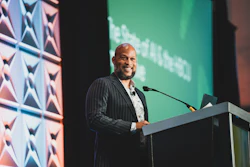
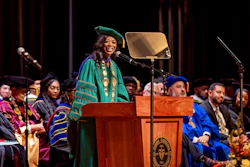
Dr. Cheryl Mango grew up in an HBCU family – and, more specifically, a Grambling State University family.
Log in to view the full article
Dr. Cheryl Mango grew up in an HBCU family – and, more specifically, a Grambling State University family.
Her parents attended Grambling State University, as did her brothers. Her dad, Elton “Bull” Mango, played football under legendary Coach Eddie Robinson, and all of his siblings attended HBCUs.

“I love the HBCU experience so much, because I understood in a racist town that I grew up in – Black people couldn’t work in the bank, we couldn’t be cheerleaders – [but] white people treated my family [with respect],” she says.
She watched HBCUs raise each member of her family into successful businesspeople – lawyers, doctors, engineers, patent-holding inventors, multi-millionaire entrepreneurs, local politicians. In her small town of DeRidder, Louisiana, she says she appreciated being immersed in an array of Black experiences – from playing Spades on the front porch to traveling with the mayor to lobby for important legislation in Washington, D.C.
When she did matriculate to Grambling, she says, her professors surrounded her like an extended family, making sure she lived up to the community’s expectations of her. And when she graduated and went on to pursue her master’s degree at neighboring Louisiana Tech University – where she was the only Black person in the history program – it was her former professors at Grambling who reached out to her, tutored her, mentored her, read over her papers, and helped her see it through to the end. That’s how she knew she had to go back to an HBCU for her Ph.D. in history.
And it was there, in the classrooms at Morgan State University, that Mango says the idea of an HBCU Studies program grew roots in her mind.
“The questions that we were dealing with at the PWI were – I'm having to debate whether racism even exists. But when I got to Morgan, and we’re all in there debating and doing diagnostics on Black history and Black problems with our professors, and we’re competitive with each other,” she recalls, adding it was such a relief after being in an environment where discussions were surface level debates about racism and her being left out of study groups because of it.
“HBCUs helped me to psychologically process race,” she says.
Then, she went on to intern in the White House Initiative on HBCUs within the U.S. Department of Education, and she realized that many people who worked in the office didn’t understand how the office had been formed. That question, she says, opened up her entire professional trajectory and laid the foundation for her to create the nation’s first HBCU Studies program at Virginia State University in 2020.
“We're in these institutions, we love them, but we don’t quite understand them,” she says. “Most of us understand vaguely the history of them. We understand that they have some sort of magic associated with them. We understand that they have done these amazing things in history. But we have not had a systematic way to analyze [and critique] them.”
Mango says HBCU Studies is an extension of African American studies, in the same way Hip-Hop Studies might be.
“Ultimately, I felt that HBCU graduates first needed to be trained [on] how to understand their experience in real time,” she says. More importantly, though, she says the goal is for HBCU graduates to leave their institutions ready to help solve the problems facing their alma maters, not just contribute to corporate America, various government agencies, or even other institutions.
“We have all of this culture, which is our currency. We have a leadership culture, a business culture. What is our sociological culture, what is our music culture, what are our contributions to sports?
“I felt that it was a social justice issue,” she continues. “I would hear complaints about HBCUs not having African American Studies programs. If I wanted to get a Ph.D. in African American Studies, I would not be able to do that at an HBCU.”
“It's not just for HBCUs – it's for HBCUs first,” she continues, “but we have a model that’s worthy of study beyond the HBCU, because we have done it with limited resources. [People] can identify more with HBCU media culture, and HBCU financial culture more than a Harvard model. We're talking about turning a formerly enslaved population into a thriving economic class.”
Mango says what makes HBCUs so special isn’t just the fact that the institutions do more what less, or even that they have survived integration and have had the support – whether passive or active – of U.S. presidents of both parties. It’s more about the bigger story of how they nurtured and educated a group of people born to anti-literacy laws into an entire intellectual and cultural revolution in the Harlem Renaissance only 50 years later.
“HBCUs are part of the soft power of the United States, because they have kept African Americans aspirational,” she says.
“In 250 years, if America has anything to brag about ... if the Statue of Liberty needs to hold something up, it needs to hold up HBCUs. Because they represent everything that the Statue of Liberty stands for, ... everything this quote-unquote nation is supposed to stand for. In 250 years, I think HBCUs are America’s crowning achievement.”
This story originally ran in the August 6 issue of The EDU Ledger magazine.