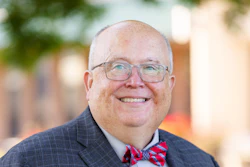
Dr. Ibram X. KendiThe small Indian takeout restaurant in Atlanta’s historic Auburn Avenue district hummed with quiet conversation as Dr. Ibram X. Kendi settled into a corner booth, his presence both commanding and understated. Just blocks away, the eternal flame burned at the tomb of Dr. Martin Luther King Jr. and Coretta Scott King—a proximity that felt anything but coincidental as one of America’s most influential scholars on racism prepared to discuss his return to historically Black higher education.
In early August, Kendi will officially begin his tenure as a professor of history at Howard University and founding director of the Howard Institute for Advanced Study. It’s a homecoming of sorts—not just to the Washington, D.C. area where he once lived, but to the HBCU ecosystem that has long been central to his scholarship and personal mission.
“I remember people kept saying the same thing over and over again: ‘Welcome home,’” Kendi says, reflecting on the announcement of his move to Howard that was made earlier this year. “It certainly gives me a feeling of peace and joy that I’ve never experienced before when I moved to a new institution.”
From journalism to academia
Dr. Ibram X. Kendi in conversation with Dr. Angela Y. DavisThis sense of coming full circle was perhaps most evident in the arc of Kendi’s impressive career trajectory. The scholar who has become synonymous with anti-racist education began his journey in journalism, including a summer internship at Diverse: Issues In Higher Education during his graduate studies at Temple University. That early exposure to covering higher education proved formative, helping him develop the accessible writing style that would later enable him to make complex academic concepts more digestible for mainstream audiences.
As an undergraduate at Florida Agricultural and Mechanical University (FAMU), Kendi was certain that he would pursue a career in journalism and believed that by pursuing a master’s in African American studies at Temple, he would enhance his expertise so that he could become a better journalist covering Black communities.
“I didn’t want to assume because I was Black, that I was an expert on Black people,” he says. “So, I needed to really sort of study the Black experience so I could be better able to cover Black people.”
Graduate school changed everything. What began as professional development for journalism became a calling toward scholarship. Yet the journalistic training never left him. When he wrote Stamped from the Beginning, which won the National Book Award and catapulted him to national prominence, he drew on both skillsets.
“I was able to revisit the sort of muscle that I had learned being trained as a journalist, while also being able to flex the new muscle of academic research,” he says. “Most academics, unfortunately, are not trained to write for the general public.”
A breakthrough book and national recognition
The success of Stamped from the Beginning marked a pivotal moment—not just for Kendi personally, but for public discourse around racism in America. The book, which took three and a half years to research and write, emerged from what was originally intended as a single chapter for a different book project about Black studies programs.
“I was writing my first book, which was on Black campus movement,” Kendi recalls. “I decided that for my second book, I was going to write a book specifically on the origins of Black Studies, and in writing that book, I decided that my first chapter was going to be a sweeping sort of history ofscientific, racist ideology.”
That chapter expanded to 190 pages and became the foundation for what would become, perhaps, his most influential work. The timing was also fortuitous in unexpected ways—his wife was bedridden in the hospital when the book was released in April 2016, and Kendi did just one radio interview and received one review in The Washington Post.
Log in to view the full article
Dr. Ibram X. KendiThe small Indian takeout restaurant in Atlanta’s historic Auburn Avenue district hummed with quiet conversation as Dr. Ibram X. Kendi settled into a corner booth, his presence both commanding and understated. Just blocks away, the eternal flame burned at the tomb of Dr. Martin Luther King Jr. and Coretta Scott King—a proximity that felt anything but coincidental as one of America’s most influential scholars on racism prepared to discuss his return to historically Black higher education.
In early August, Kendi will officially begin his tenure as a professor of history at Howard University and founding director of the Howard Institute for Advanced Study. It’s a homecoming of sorts—not just to the Washington, D.C. area where he once lived, but to the HBCU ecosystem that has long been central to his scholarship and personal mission.
“I remember people kept saying the same thing over and over again: ‘Welcome home,’” Kendi says, reflecting on the announcement of his move to Howard that was made earlier this year. “It certainly gives me a feeling of peace and joy that I’ve never experienced before when I moved to a new institution.”
From journalism to academia
Dr. Ibram X. Kendi in conversation with Dr. Angela Y. DavisThis sense of coming full circle was perhaps most evident in the arc of Kendi’s impressive career trajectory. The scholar who has become synonymous with anti-racist education began his journey in journalism, including a summer internship at Diverse: Issues In Higher Education during his graduate studies at Temple University. That early exposure to covering higher education proved formative, helping him develop the accessible writing style that would later enable him to make complex academic concepts more digestible for mainstream audiences.
As an undergraduate at Florida Agricultural and Mechanical University (FAMU), Kendi was certain that he would pursue a career in journalism and believed that by pursuing a master’s in African American studies at Temple, he would enhance his expertise so that he could become a better journalist covering Black communities.
“I didn’t want to assume because I was Black, that I was an expert on Black people,” he says. “So, I needed to really sort of study the Black experience so I could be better able to cover Black people.”
Graduate school changed everything. What began as professional development for journalism became a calling toward scholarship. Yet the journalistic training never left him. When he wrote Stamped from the Beginning, which won the National Book Award and catapulted him to national prominence, he drew on both skillsets.
“I was able to revisit the sort of muscle that I had learned being trained as a journalist, while also being able to flex the new muscle of academic research,” he says. “Most academics, unfortunately, are not trained to write for the general public.”
A breakthrough book and national recognition
The success of Stamped from the Beginning marked a pivotal moment—not just for Kendi personally, but for public discourse around racism in America. The book, which took three and a half years to research and write, emerged from what was originally intended as a single chapter for a different book project about Black studies programs.
“I was writing my first book, which was on Black campus movement,” Kendi recalls. “I decided that for my second book, I was going to write a book specifically on the origins of Black Studies, and in writing that book, I decided that my first chapter was going to be a sweeping sort of history ofscientific, racist ideology.”
That chapter expanded to 190 pages and became the foundation for what would become, perhaps, his most influential work. The timing was also fortuitous in unexpected ways—his wife was bedridden in the hospital when the book was released in April 2016, and Kendi did just one radio interview and received one review in The Washington Post.
“Very few people even knew,” he says of the book’s initial reception. It was a stark contrast to the national book tours and extensive media coverage that would accompany his later works, a trajectory that Kendi acknowledges with deep humility. “That’s one of the reasons why I don’t really take any of these accomplishments for granted.”
The scholar’s meteoric rise to national prominence brought opportunities and challenges in equal measure. Centers and institutes at American University and Boston University provided platforms for his work, but also revealed the complexities of academic leadership and public intellectualism.
“Because of my name, there’s another layer of expectation that people expect in terms of my management and my presence,” he reflects on the demands of directing high-profile research centers. The experiences taught him valuable lessons about sustainability and scale that he’s applying to his new venture at Howard.
Choosing community over resources
For Kendi, the move to Howard represented more than just a career transition—it was an alignment of values and mission that had been years in the making. His conversations with Howard leadership began six years ago, long before recent challenges at other institutions made the move feel urgent.
“I have been thinking about Howard as a destination institution for a long time,” he says. “I understood its history. I admired its legacy. I understood what Howard has meant to the history and to the culture.”
The decision also reflected a broader philosophy about the relationship between resources and community in academic work.
“For me, the community and the support is much more important than resources,” Kendi explains. “I want to live a life of both joy and impact. And I feel as if I could have more joy and impact at Howard University.”
This philosophy extends to his understanding of HBCUs more broadly. Speaking to administrators and foundation leaders at the United Negro College Fund’s UNITE 2025 conference in July, Kendi articulated a vision that challenged deficit narratives about historically Black institutions.
“I’ve spent really the last nine years of my career making the case that there was nothing wrong with Black people as a group,” he told the gathering of HBCU leaders. “But I’ve also simultaneously pushed back against the idea that there was something wrong or inferior about Black institutions.”
The HBCU Brilliance Initiative, which Kendi now serves as a strategic advisor, has embodied this philosophy. The program is focused on strengthening HBCUs by providing them with crucial resources and support. It aims to help these institutions enhance their financial stability, attract and retain capital, and better serve their communities. The initiative, spearheaded by the Reinvestment Fund, assistance, and networking opportunities to these storied institutions. Rather than asking HBCUs to “do more with less,” the initiative provides capital, coordination, and technical assistance to help them thrive.
“What if we stopped asking HBCUs to survive under scarcity and started investing in their capacity to thrive?” Kendi asked the conference attendees, his voice carrying the weight of years spent studying institutional racism.
Howard’s provost, Dr. Anthony K. Wutoh, has celebrated the hire. During his tenure, he has successfully helped to lure other prominent writers and scholars to The Hilltop— most notably Nikole Hannah-Jones and Ta-Nehisi Coates.
“Dr. Ibram X. Kendi’s exceptional scholarship and unwavering commitment to social justice align perfectly with Howard University’s mission and values as we deepen our scholarship on the African Diaspora,” says Wutoh, who was instrumental in hiring Kendi. “We are confident that under his leadership, the new institute will become a beacon of excellence and a catalyst for transformative change.”
Building the Institute for Advanced Study
The new Institute for Advanced Study at Howard will operate on similar principles. Modeled after prestigious institutes at Princeton, Stanford, and Harvard, it will offer competitive residential fellowships, continue publishing The Emancipator—the journalistic enterprise that Kendi created while at Boston University—and host public events. The institute will also address deep and persisting inequities in areas including, but not limited to, technology, the environment, healthcare, the economy, governance, education, and the criminal legal system.
Crucially, it will reserve fellowships specifically for HBCU faculty—addressing a systemic issue Kendi has observed in academic hierarchies.
“One of the reasons why there’s so many residential fellowship programs at historically white universities... is that these elite, historically white institutions are subsidizing the sort of more mid-tier, or lower income historical white institutions,” he explains. “[HBCUs] don’t necessarily have access to that form of subsidy.”
The institute represents Kendi’s understanding that anti- racist scholarship cannot be done in isolation. Throughout his career, Howard University had appeared in virtually every book he’s written—from chronicling student activism in the 1960s to profiling faculty who challenged racist ideas in earlier decades.
“Howard was showing up in pretty much every book,” he notes. “You had Howard faculty who had been pretty pivotal in challenging racist ideas.”
Names like E. Franklin Frazier, Nathan Hare, Sterling Brown, and Rayford Logan populated his work—scholars who built intellectual community while advancing civil rights and challenging white supremacy. For Kendi, joining this tradition felt both natural and necessary.
“How much and how important it is for us as scholars or activists to really be in community,” he reflects. “These scholars were obviously in community, in collaboration, inspiring each other, learning from each other.”
The symbolism of place
The symbolism of discussing this work in Atlanta—a city synonymous with civil rights leadership and HBCU excellence— wasn’t lost on Kendi or me. As the afternoon approached and the restaurant began to empty, he reflected on the broader implications of his career trajectory.
His journey from journalism student to public intellectual mirrored broader changes in how academic knowledge intersected with public discourse. The skills developed during that early internship at Diverse—learning to translate complex ideas for broader audiences—would prove essential as his scholarship gained national attention.
Yet for all his public prominence, Kendi remains fundamentally an introvert who prefers writing to speaking, and research to celebrity.
“I still get nervous,” he admits, before delivering a keynote speech. “I prefer writing. I’d rather just be alone somewhere writing.”
This tension between private scholarship and public engagement has defined much of his career. The decision to move to Howard represented, in part, a desire to recalibrate that balance—to work within a community of scholars who share his commitment to anti-racist education while helping to build institutions that could sustain this work beyond any one individual.
“You can’t do this work alone,” he says. “I’m constantly learning from other scholars and trying to support other scholars and wanting to work with other scholars.”
For a scholar who has spent his career documenting how racist ideas have evolved and persisted, the move to Howard represents both continuity and transformation. It’s a return to the HBCU tradition that has shaped his scholarship and a bet on the future of institutions that have long served as laboratories for racial justice.
“Coalition that knows education is not just a pathway to jobs, but as a pathway to power and freedom,” Kendi told the conference attendees at the UNCF convening, outlining his vision for HBCUs in the 21st century.
As Kendi prepared to leave Atlanta to make his way back to Washington, D.C., that vision seemed less like aspiration and more like an inevitable destination. The young man who once didn’t believe he was “college material,” who found his brilliance nurtured at Florida A&M, was now returning to historically Black higher education not just as a professor, but as a keeper of the flame—ready to light the way for the next generation of scholars and activists who would carry this work forward.

 Dr. Ibram X. Kendi
 Dr. Ibram X. Kendi in conversation with Dr. Angela Y. Davis