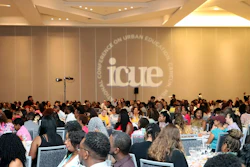
Dr. Stacey Patton told that story on Oct. 6 to more than 200 people gathered in Washington, D.C. for the launch of her new book, and she refused to let anyone mistake the evening for a party.
“Tonight is a repast,” she said, “a repast for untold numbers of Black children who were snatched from the future.” In the Black tradition, families gather after a homegoing to eat, share stories, and keep grief from having the last word. Most of the children in her book never received a funeral at all.
“Some of their parents were too terrified to claim their bodies,” Patton said. “Some were so mutilated or burned that there was hardly a body left to claim.” White spectators carried pieces of Black children home from lynchings as souvenirs and displayed them in their houses. “Somebody’s baby reduced to somebody else’s keepsake,” she told the crowd.
Her powerful new book, Strung Up: How White America Learned to Lynch Black Children, is one of the most important works of American history published in a generation, and it belongs in every classroom where we claim to teach the truth about this country.
The cover photograph makes its case before a reader turns a page. Taken during World War I at Camp Zachary Taylor in Louisville, Kentucky, it shows white soldiers staging a “mock” lynching of a Black boy who looks eight or nine years old. Patton counted the white hands on the rope and stopped at six. Six grown men did not need to grip one rope to overpower one small boy, and yet that excess shows the cruelty was communal.
Patton did not spend more than a decade in the archives, she told her audience, to produce “another catalogue of American atrocities.” She went searching for answers to a much harder question.
“What happens to a society that teaches its children to watch other children suffer and die?” she asked. Lynchings destroyed the Black child on the tree or the bridge, and Patton argues that it also schooled the white child in the crowd.
“It taught the white child standing beneath it watching. And those children grew up,” she said. They became parents and teachers, police officers and physicians, judges, politicians and journalists. “They decided which children deserved tenderness and which children deserved suspicion,” Patton added, “which children got second chances and which children got sentences.”
The moment that reshaped her book came at Howard University’s Moorland-Spingarn Research Center. Patton opened a folder and found a lynching photograph with a little white girl in the frame. The caption read: “This is her first lynching.” Patton felt sick, closed the folder, and left the archive to spend time around children until she could steady herself. Later, a Howard psychologist asked her how old the girl was. Patton guessed between five and seven, and the psychologist explained that a child that age is in a sensitive period of brain development, mirroring the joyful adults around her to stay safe and attached. Patton immersed herself in the classic literature of developmental psychology and then threw out everything she had written.
“People think that racism is perpetuated through bad ideas, through hatred,” she said. “No, it’s perpetuated through love, through bonds between white parents and their children.”
That insight carried Patton across the Atlantic. In English and European records, she found crowds of thousands gathering for floggings, burnings and hangings, with children pushed to the front as the intended audience. Corpses rotted for weeks in iron gibbets so the whole town could smell the lesson. Europeans executed their own children as well. The youngest Patton found was six, and she documented a mass public hanging of 10 children in England. During the colonial period, she explained, most children executed in America were white, and the gallows turned toward Black children after emancipation.
“What Black people got was something uniquely scaled up and racialized,” she said, “but it was also European.”
Patton came to this history through both of her families. She was separated from her birth family as a baby and raised by adoptive parents, and lynching had scarred both bloodlines. The book began, she read from the epilogue, with old news clippings and police photographs of the murder of her biological grandfather in the winter of 1969.
“It was a crime that was never called a lynching,” she read, “because by the time he was killed, America had learned to rename its violence.”
Patton still wonders what her life would have been had he not been hog-tied, shot, and thrown into a swamp, and whether her mother, wounded by his death as a young girl, might still be alive. The terror reached her adoptive family, too. Patton recalled sitting in church as her adoptive grandfather wept while describing how the Klan had killed his father in Mississippi, wrapped the body in white sheets, and thrown it down in front of his mother and siblings. In both homes, the adults met children’s questions with silence, and Patton grew up determined to answer them.
She also told the story of Freddie Moore. In October 1933, in Assumption Parish, Louisiana, a mob dragged the 16-year-old from the jail in Napoleonville after he was accused in the killing of a 15-year-old white girl. The men tortured him and hanged him from a bridge over Bayou Lafourche, where his body stayed on display for a full day. Patton said the evidence later pointed to a man in the girl's own household, who was never prosecuted.
“As long as a Black boy paid the price,” she said, “nobody cared.”
Patton rejects the popular explanation that white Americans simply mistook Black children for adults. The mobs knew exactly whom they were killing, she argues, and first had to persuade themselves that a Black child possessed no childhood worth protecting. She traces that machinery well past the lynching tree.
“History does not stay politely in the past simply because we put a date underneath it,” she told the room. “Violence leaves instructions.”
When commentators wave away Black suspicion about a string of recent deaths, including the July death of 18-year-old Nolan Wells, Patton points to the long record of coroners and police departments labeling murders as accidents and suicides.
“Black people are pattern-recognizing people,” she said. “That's the thing that has kept us alive for generations. We're not seeing ghosts.”
Patton’s book now needs to reach far beyond African American studies seminars. High school history teachers should assign it, and teacher preparation programs should use it to help future educators examine how they see the Black children in their classrooms. Medical, law, and social work faculties will find their own professions in its pages, since Patton follows racial terror into hospital wards, courtrooms, and coroners' reports. Journalism schools owe their students a reckoning with it, because newspapers announced these killings, narrated them and excused them. Every Historically Black College and University (HBCU) should put it on a syllabus. Patton also issued a charge to readers outside the academy. With museums and public archives under political pressure, she urged those in the room to become “citizen archivists, citizen historians,” recording their elders and keeping family papers so that no single institution can erase what happened.
Critics who call this material too disturbing for young people forget that Black children were never spared it. Lawmakers in statehouses across the country are pressuring teachers to soften or skip the hardest chapters of the American story, and this book will test whether we trust students with the truth. Congress did not make lynching a federal hate crime until 2022, when it passed a law named for Emmett Till, a 14-year-old boy from Chicago. That law came 122 years after Rep. George Henry White of North Carolina, the last Black congressman of the post-Reconstruction era, introduced the first federal anti-lynching bill. A nation that needed more than a century to outlaw the mob murder of children has not finished learning this lesson.
Patton knows many Black readers dread what waits inside these pages. She promises to take them by the hand through what she calls a chamber of horrors and bring them out on the other side changed. She also refuses to manufacture a redemptive ending, because these were real children who should be alive today as elders. Instead, she sent the room home with instructions.
“We have to love Black children before the obituary,” she said. That love, she argued, cannot be sentimental or passive, and it cannot show up only “after the blood has dried with flowers, hashtags, murals, memorials, and prayers.”
I accept that charge, and I hope every reader of this column will join me. Buy the book, read it slowly, and then teach it, assign it, and argue over it at the dinner table and in the faculty senate. Patton closed the evening with the final pages of her epilogue, addressed to the people who built this machinery: “We will live, and our living will be your indictment.”
Maggie Howze fought three times on that bridge to live, and the least we owe her is the courage to read what happened to her and countless others.
Dr. Jamal Watson is a higher education consultant, professor and associate dean of Graduate Studies at Trinity Washington University and the author of this bi-weekly column. Watson is the former executive editor of Diverse: Issues In Higher Education (now The EDU Ledger) and is the author of The Student Debt Crisis: America’s Moral Urgency (Broadleaf Books, 2025).